
So let me start by saying that this isn’t an article about liveaboards in Komodo: if that’s what you are looking for, jump on liveaboard.com and look there (or read the liveaboard section of this guide). Here you will find all the information about Labuan Bajo diving and Komodo diving: the dive schools you can find here, the different sites, the costs and whether it’s worth it, plus an explanation of why I think you should go snorkelling with the mantas as well.
Labuan Bajo diving: my quick answer
Best sites I dived: Karang Makassar (Manta Point), where I saw 10 mantas on the first day, and Batu Bolong, a wall dive full of corals and colourful fish.
What a day of diving costs: Rp 5,087,500 for 2 days of diving with Uber Scuba, 6 dives in total.
Experience level needed: technically speaking Open Water, but get your Advanced and some experience first, because the currents can get dangerous.
Why Trust This Guide on Diving in Komodo
We spent a week in Komodo following our disastrous trip to Misool, and after seeing all the days of diving that we had planned in Raja Ampat suddenly cancelled I knew that we needed to lift our spirits once in Komodo and get some great diving done. My boyfriend was sick the first day we arrived, so I used the occasion to pull out the list of the top-rated diving centres in Labuan Bajo and I spent a day going door to door asking for information and prices for the different dive trips (and also eat a good amount of sushi, but more on that in my guide on where to eat), until I found not only the cheapest one but also the one that was going to provide us with the best quality.
Curious about Komodo vs Raja Ampat? Read this section at the end of the guide

Labuan Bajo Dive Schools: My Uber Scuba Review
After going around and speaking with the main dive schools in Labuan Bajo I decided to book with Uber Scuba, and these are the 3 reasons why you should do it as well:
- Their price was the cheapest at the time I went (I give you all the numbers in the cost section below).
- They have amazing reviews, so you don’t have to count just on mine.
- They cook the lunch on the boat and the food is incredibly good.
They usually dive in Central and North Komodo, but they visit the north just once or twice per week, and never in the three to four days after the full moon or new moon, when the currents are too strong to go. The north is also not an option in the wet season, from November to April.
We booked two days of diving, as they guarantee that if you book two consecutive days you will go to different sites, and on both days we had a really good experience. The boats are big, with plenty of space to chill on the top deck and mattresses where you can lie down, and everything was very well organized: they take care of changing the gear for you and setting it up so you don’t need to do anything (they even help you put on the fins while you are gearing up, which honestly no one had ever done in the other schools, and it was a funny experience).
When you arrive you already have breakfast ready on the boat, with some doughnuts and other sweets, and they always give you banana fritters, pineapple and papaya as a snack. The lunch changes between the days so you don’t end up eating the same thing every day, and the portions are very abundant, with vegetables, meat, eggs and tempeh (after I told them that I like it they came back with a full plate of tempeh just for me, which I didn’t even manage to finish). Toward the end of the dives they divide the guests in two groups based on the amount of air that they have left, which is always a nice touch when dealing with a group of experienced divers as it gives the possibility to everyone to stay as long as their air consumption permits them to. Also, the dive school is literally next to the taxi point in Labuan Bajo… which is an additional bonus point when you get back and you just want to go straight to your hotel after a day of diving.
The dive sites I visited were Mawan, Tatawa Besar, Sebayur Kecil, Batu Bolong, Karang Makassar and Siaba Kecil. To be honest, only two really stood out to me.
The first was Karang Makassar, also known as Manta Point, where I saw 10 mantas on the first day and, especially towards the end of the dive, it was just me and two other divers. The second was Batu Bolong, the iconic dive site, famous for its incredible coral formations and abundance of fish, which was absolutely beautiful to explore. At one point, a huge turtle sneaked up behind me and, when I turned around, it was practically right in front of my face (quite a spooky experience!).
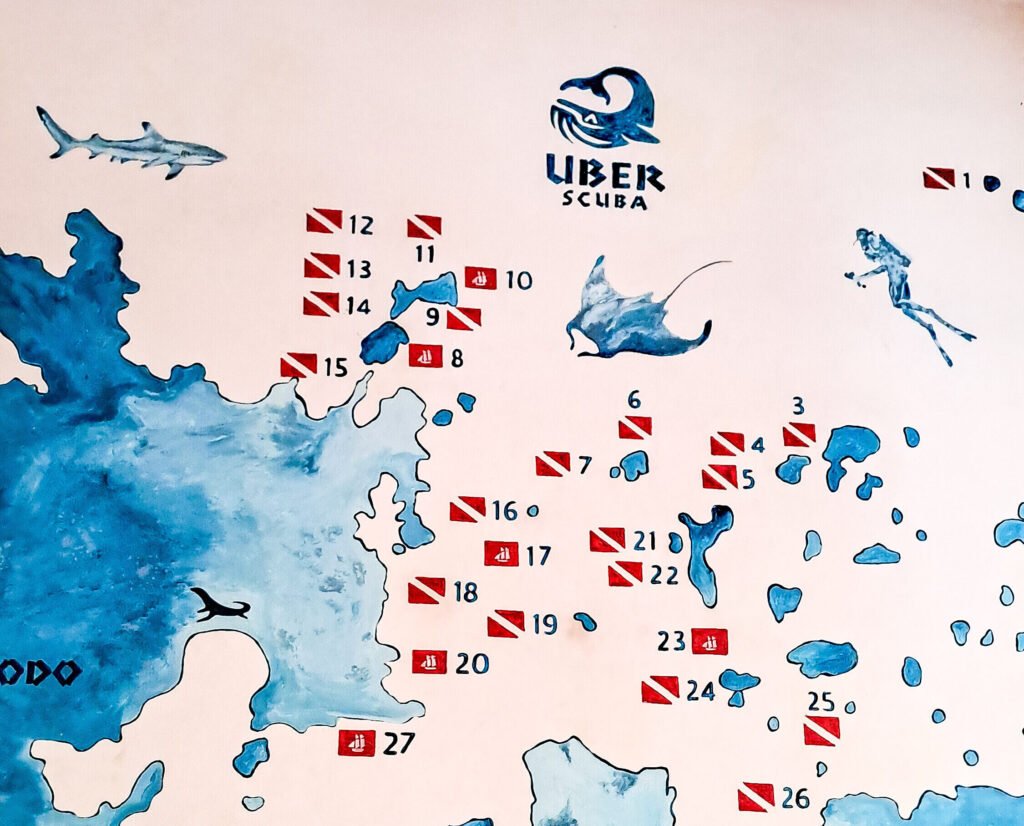

What a Day of Diving in Komodo with Uber Scuba Looks Like
So here is some bad news for the people that enjoy sleeping in: diving in Labuan Bajo requires an early wake up call, especially if you are staying outside the city centre. You leave around 7 to go to the pier, which means that you will need to be at the dive school at 6-6:30 every morning (the time at which the majority of coffee places around are still closed, so if you want a coffee go to Carpenter Cafe and Roastery). At the dive school they check that everyone is there, divide the groups based on the boat you will go on (they have 2 boats) and give you the QR code that you need to scan at the port before you can access the area with the boats (but don’t worry, you will all go together).
When you arrive on the boat the equipment is already set up for you, so unless you have your own you can go directly to have breakfast (if you have your own equipment and dive for multiple days they will wash it for you), and then you can chill or take a nap, as it’s usually a 70 minute ride to the dive sites (download some movies to watch on the way and bring some warmer clothes or a dive poncho, as it can get windy).
Then it’s the usual briefing, first dive, snack, briefing, second dive, delicious lunch, briefing and third dive, and snacks again, because we know that when it comes to diving and snacks it’s never enough. Just be mindful that, especially when changing sites and on the way back, there can be strong waves, so hold your plate and don’t leave a hot cup of tea or coffee on the table (I did it and I almost got burned when it fell off because of the waves) and if you need something for sea sickness, take it sooner rather than later.
After the dives there are another 70 minutes back to the pier, where you will arrive around 18:00. The dive sites are chosen each day based on the divers’ certification and experience and on the tides, and they rotate every 3 to 4 days.
Tip: When I first contacted the schools they recommended that I pre-book, as September is part of the high season there and they couldn’t guarantee that I would find space if I booked once in Labuan Bajo. To be honest it wasn’t necessary: they still had quite some space, and even if the dive school you want to go to is full there will always be another one with some availability. Booking in person also keeps you flexible in case Komodo National Park is closed on some days (I explain why this might happen in my guide).

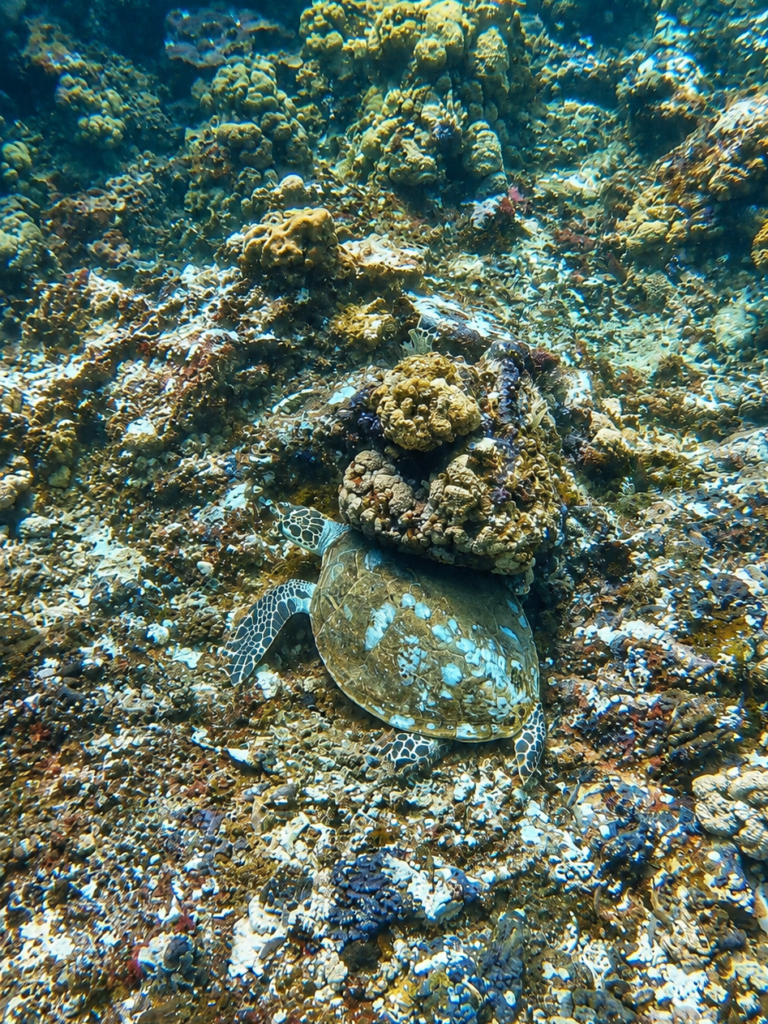
Diving in Komodo means plenty of mantas, but also turtles
When Is the Best Time to Dive in Komodo?
The best time to dive in Komodo is during the dry season (April to November), when there is less chance of having dive days cancelled due to the weather or the park being closed (to be fair, we were there in September and it was quite windy on the days we went diving, so don’t count on the dry season as a guarantee of always great weather). But be aware because it’s also the time when the cold upwelling brings cooler water and the southern and central sites can have a water temperature of 22-26 °C.
While the peak of the manta season in Komodo is January to March (which corresponds with the wet season), you don’t need to worry about not seeing mantas outside those months because, as I found out, being outside the main manta season doesn’t really change much: we saw them every single day, both while diving and snorkelling.
How Much Does Diving in Komodo Cost?
So the bad news is that diving in Komodo isn’t exactly cheap, due to the long boat rides and the park fees. I went with Uber Scuba and, thanks to a small discount, I paid Rp 5,087,500 for 2 days of diving, 6 dives in total. The usual prices are Rp 2,250,000 for 2 dives in a day, Rp 2,750,000 for 3 dives in a day and Rp 5,225,000 for 3 dives per day for 2 days, plus the National Park Marine fee, which is Rp 300,000 per person per day.
Is It Worth Diving in Komodo?
I feel like this is my answer to pretty much everything in Komodo… yes and no.
We saw the mantas every day and the first day I saw 10 in one dive, so if mantas are on your marine bucket list you should definitely go. We also saw plenty of good reefs and fish, so I cannot say that the diving itself wasn’t good, but there were 2 main issues.
The first one was the current: especially on the first day it was incredibly strong and extremely tiring (think about kicking at the maximum of your strength and basically not moving), which made it very hard to enjoy what was around us while constantly fighting against it. The second was the water temperature: let me be honest, I do tend to get cold in the water, but even with a thick full wetsuit I was still freezing, which definitely wasn’t pleasant.
For these reasons we decided not to extend our diving days (and also because, honestly, I wanted mainly to see the mantas and after seeing them 22 times between diving and snorkelling I was definitely more than satisfied).
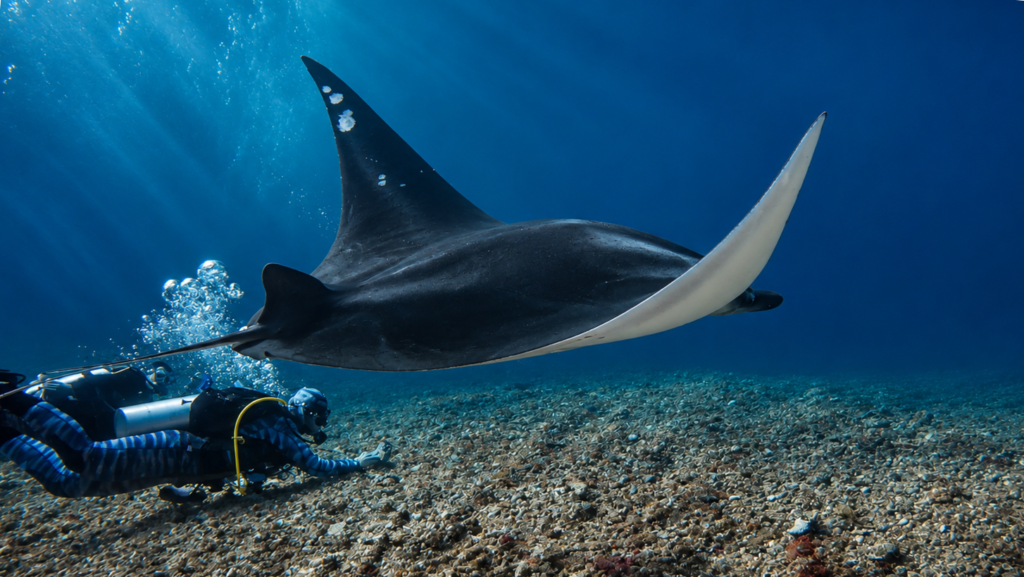

Can You Learn to Dive in Komodo? Is Open Water enough?
Like everywhere else, there are diving courses in Labuan Bajo too, but you need to understand that schools make a lot of money with courses, so just because a place offers them it doesn’t mean that it’s a good one to learn in. This is just my personal opinion, based on what I saw as someone that dived here with quite some experience, so don’t take it as universal truth, but I would definitely discourage you from learning how to dive in Komodo, or coming here without much experience, for 3 simple reasons:
- Currents: even at the calmer sites, diving in Labuan Bajo is a constant fight against the currents, and even when the guides told us there wouldn’t be much we were surprised by them in the middle of the dive. It can get scary, and panicking in a current is dangerous even for an experienced diver. So even with an Open Water, make sure to be a confident swimmer, be confident in currents and know (at least theoretically) how to use a reef hook, because it will be needed.
- Water temperature: it’s cold, and if you suffer in cold water like me you will struggle to enjoy the diving here. After the first day I was already mentally done, and I joined the second one just because I had already paid for it, which is not encouraging for someone with little experience. As I said above the temperature changes with the season and the zone, but between May and September the upwelling can bring it down to 22-26 °C, and sometimes below 22 °C at depth. Even with a 5 mm wetsuit I was cold, so if you have a 7 mm or a two-piece one at home, bring it!!!
- Prices and enjoyment of the sites: Labuan Bajo is more expensive than many other places to learn how to dive (like Koh Tao, one of the cheapest places on earth, or even Gili in Indonesia, where I dived for the first time) because of the long boat rides. Paired with the currents, it’s hard to really enjoy the sites without some experience. And if you mainly want to see mantas, as I explained in my guide to the things to do in Labuan Bajo, I actually thought that snorkelling with them was by far better than diving.
As absurd as it might look, I think Labuan Bajo is a way worse place to learn how to dive than Raja Ampat, and the other divers I spoke with that did both agreed. If you want to know why I think it’s actually fine to learn there, read this article.
Why Divers Should Also Go Snorkelling With the Mantas
I am going to be honest: seeing mantas while diving gives you the chance to appreciate the marine life in a completely different way, but I had a better experience snorkelling on the full day trip to Komodo National Park from Labuan Bajo, as the place where they bring you is really shallow.
Now you might think: that’s a popular tour, so I guess I will be surrounded by 30 other people trying to swim with mantas. And the answer is yes, but. With the “but” being that the majority of people that join these tours aren’t strong swimmers and will either be holding on to the guide, who swims slowly, or still moving very slowly, so if you are a strong swimmer you will be able to keep up with the mantas and have them with no one else around. When we went we saw 7 and we spent so much time just me and my boyfriend playing with them: an incredible experience.
If you want information on which Komodo National Park tour you should book and how to find a cheap one, read my guide.
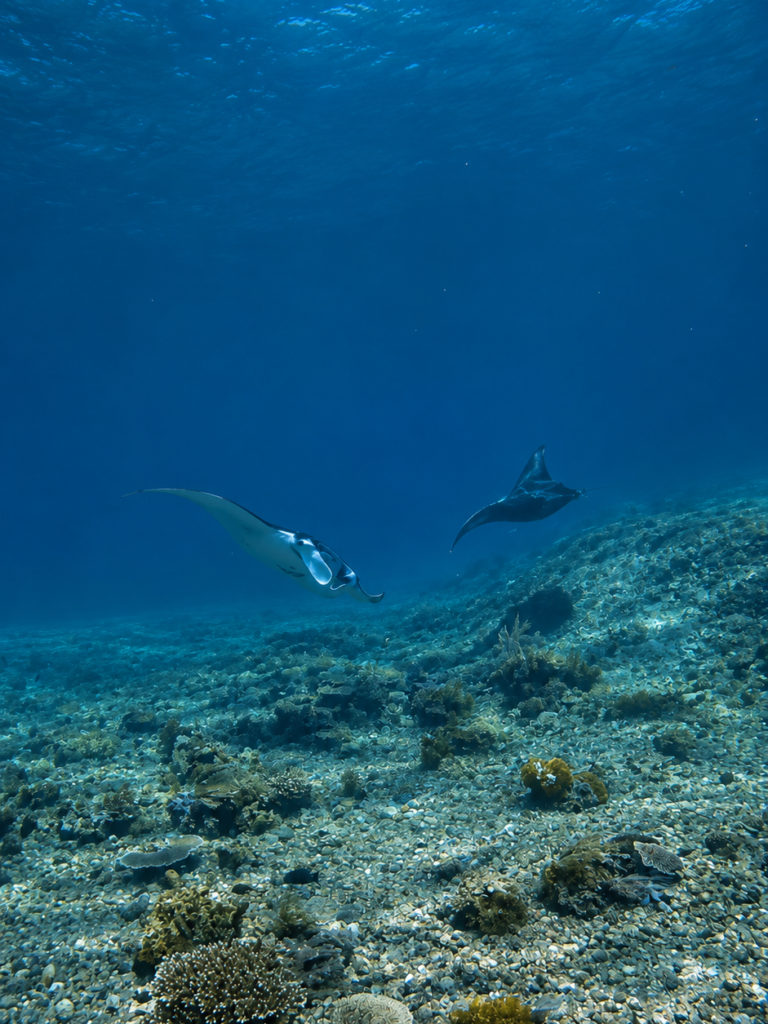
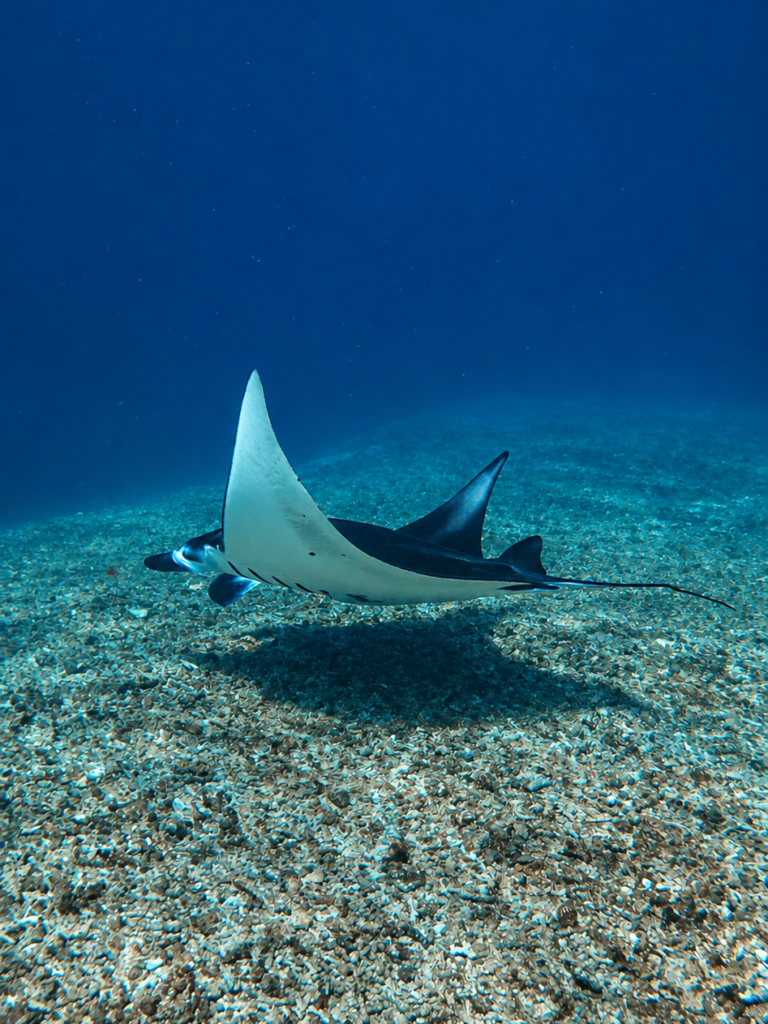
Komodo is one of the few places where the snorkelling almost beat the diving
Komodo Liveaboard Diving: How to Get a Cheap One
Honestly, unless a place can be reached just by doing a liveaboard, or the experience I want can be done just like that (think about the Banda Sea), I don’t see the sense of spending money on a liveaboard… but that’s a very personal opinion and others enjoy going on them whenever they can. If that’s what you want to do, keep reading to find out how to get a cheap one.
If you do want to do a liveaboard in Komodo without breaking the bank a friend of mine did one a few months before we went to Labuan Bajo with DiveKomodo, at the cost of Rp 14,000,000 for 13 dives, 4 days and 3 nights.
It’s a very basic liveaboard. You can have a private room if you want at no extra cost, but they are very small, all on the lower deck. There are only two bathrooms for the whole boat, the food is good but not very varied, and don’t expect the quantities you see on luxury liveaboards. The boat itself is small and cute, but there is only one area where you can objectively relax (and it’s not big enough for everyone).
That said, it costs very little and the guides are good, and so are the instructors. So if you don’t have luxury expectations or particular comfort needs, it’s perfectly fine!
Dive Equipment in Komodo: Where to Buy It
Compared to many other famous diving locations in Asia, in Labuan Bajo it’s quite hard to find well-stocked dive shops, so I wouldn’t suggest buying your gear here unless you need to (we literally had to hop around 3 locations to find a dive poncho and dive socks). If you do need to buy some gear I would go to Komodo Dive Shop, where you can find a selection of masks, socks and other items (but not a dive poncho!). If you want a poncho, the only one I found was sold at Scuba Junkie (we went to every single dive school and dive supply shop to find one, so trust my review of the shops, because I have literally seen them all).
Komodo vs Raja Ampat for Diving: My Honest Comparison
I know that people often compare these places and I am doing a comparison section as well, but the truth is that they should go in two completely different categories, both for the diving and for the locations. Komodo is mantas and strong currents, with all the comforts you need while Raja Ampat wins on everything else for me: corals, marine life, remoteness, untouchedness.
| Komodo | Raja Ampat |
|---|---|
| Mantas: Komodo wins. We saw them every single day, 22 times between diving and snorkelling, and 10 in one dive. | Mantas: you can see mantas also in Raja Ampat but it’s way less reliable and also the number of mantas in one spot is usually lower. |
| Comforts: Komodo wins. All the comforts you need: good restaurants, a dive school next to the taxi point and day dives from Labuan Bajo. | Comforts: remote, so definitely not what you go there for, if you want to get more details read my complete guide. |
| Currents: strong and tiring, like kicking at the maximum of your strength and basically not moving. Get your Advanced first. | Currents: from none to low, there are some nice drift dives but nothing too strong. |
| Water temperature: cold for me, I was freezing even with a thick full wetsuit. | Water temperature: perfect to go with a shorty. |
| Corals: plenty of good reefs, and the wall at Batu Bolong is full of corals and fish, but not the best I have seen. | Corals: Raja Ampat wins. The best corals I have ever seen, comparable to an underwater pop up gallery. |
| Marine life: a draw, Komodo wins for the big stuff. | Marine life: a draw, Raja Ampat wins for the diversity. |
| Remoteness: not remote at all, you dive from town and come back to your hotel. | Remoteness: Raja Ampat wins. Much more remote. |
| Untouched nature: Labuan Bajo and Komodo aren’t exactly hidden gems. | Untouched nature: Raja Ampat wins. Far more untouched. |


Little colourful fish surround you at every site in both places (left: Raja Ampat, right: Komodo)
Komodo Diving FAQ
Is Komodo good for diving?
Yes and no. We saw the mantas every day (10 in one dive on the first day) and plenty of good reefs and fish, but the currents were incredibly strong and tiring, especially on the first day, and the water was cold.
How much does diving in Komodo cost?
With Uber Scuba we paid Rp 5,087,500 for 2 days of diving, 6 dives in total. A friend of mine paid Rp 14,000,000 for a liveaboard with 13 dives over 4 days and 3 nights.
Can you snorkel with mantas in Komodo?
Yes: on the full day trip to Komodo National Park the place where they bring you is really shallow, and we saw 7 mantas.
When is the best time to dive in Komodo?
During the dry season, when there is less chance of having dive days cancelled due to the weather or the park being closed, even if it’s not a guarantee: we went in September and it was quite windy. The peak of the manta season is January to March (wet season), but we still saw them every single day.
How far ahead should I book diving in Komodo?
The schools recommended that I pre-book, as September is part of the high season, but to be honest it wasn’t necessary: they still had quite some space, and even if one school is full there will always be another one with some availability. Booking once in Labuan Bajo also keeps you flexible in case Komodo National Park is closed on some days.
What certification do I need to dive in Komodo?
Technically speaking an Open Water, but I would get my Advanced and some experience first, because the currents can get dangerous.
How long is the boat ride to the dive sites?
With Uber Scuba it was usually about 70 minutes each way from the pier, so download some movies and bring some warmer clothes or a dive poncho, as it can get windy.
Can I take a diving course in Labuan Bajo?
Yes, the dive schools offer courses, but I wouldn’t suggest learning how to dive here: the currents are strong, the water is cold and the long boat rides make it more expensive than in other places.
Planning Your Diving Trip to Labuan Bajo
After a day of diving, trust me, all you will want is to eat and go to bed, but don’t worry, I’ve got you covered! If you are still looking for a place to stay, I put together a guide on where to stay in Labuan Bajo, and if you are wondering where to eat after the dives (and where I ate all that sushi) here is where we ate for a week.
Diving Komodo is only one part of a trip to Labuan Bajo: for the day trips, the dragons and everything else I loved (and the one thing I would skip), read my guide to the best things to do in Labuan Bajo, and if you want to plan your days you can follow my Labuan Bajo itinerary.
If you have any questions about Labuan Bajo diving, leave a comment below. I’m always happy to help you plan your trip!
Disclosure: some links in this post may be affiliate links. If you book through them, I may earn a small commission, at no extra cost to you.