
When I started planning my first trip to Raja Ampat, finding accommodation was one of the most challenging parts. Raja Ampat is not the kind of place where you can just open Booking.com, pick the hotel with the best reviews and book a room. The resort offers were confusing to read and all seemed outside my budget (they are indeed way more expensive than homestays, but I’ve put together a selection with the best value in case a homestay isn’t for you), and I didn’t know what to expect from a homestay, or how to find and book one.
But after two trips and almost two months travelling across the Dampier Strait and Misool, this is the Raja Ampat accommodation guide I wish I’d had.
Here you’ll find who a homestay is for and when a resort is worth it, how to find and book a homestay in Raja Ampat, what to expect once you’re there, and my recommendations for the best Raja Ampat homestays and resorts in each area.
Still deciding which islands to visit? Start from my complete guide to the islands of Raja Ampat and then come back here.
All the prices in this guide (homestays and resorts) are the ones I paid or was quoted in 2026. Prices in Raja Ampat change often, so please double-check them with your homestay or resort before you book.

Homestay or Resort in Raja Ampat: What to Expect
Not sure whether a homestay or a resort is the right choice for you? Read the short comparison below. Already decided? Jump straight to the main resorts or to how to find and book a homestay.
Homestays: What to Expect
During my travels in Raja Ampat I’ve experienced both the best and the worst of what homestays can offer, but before getting into that, here is the short version.
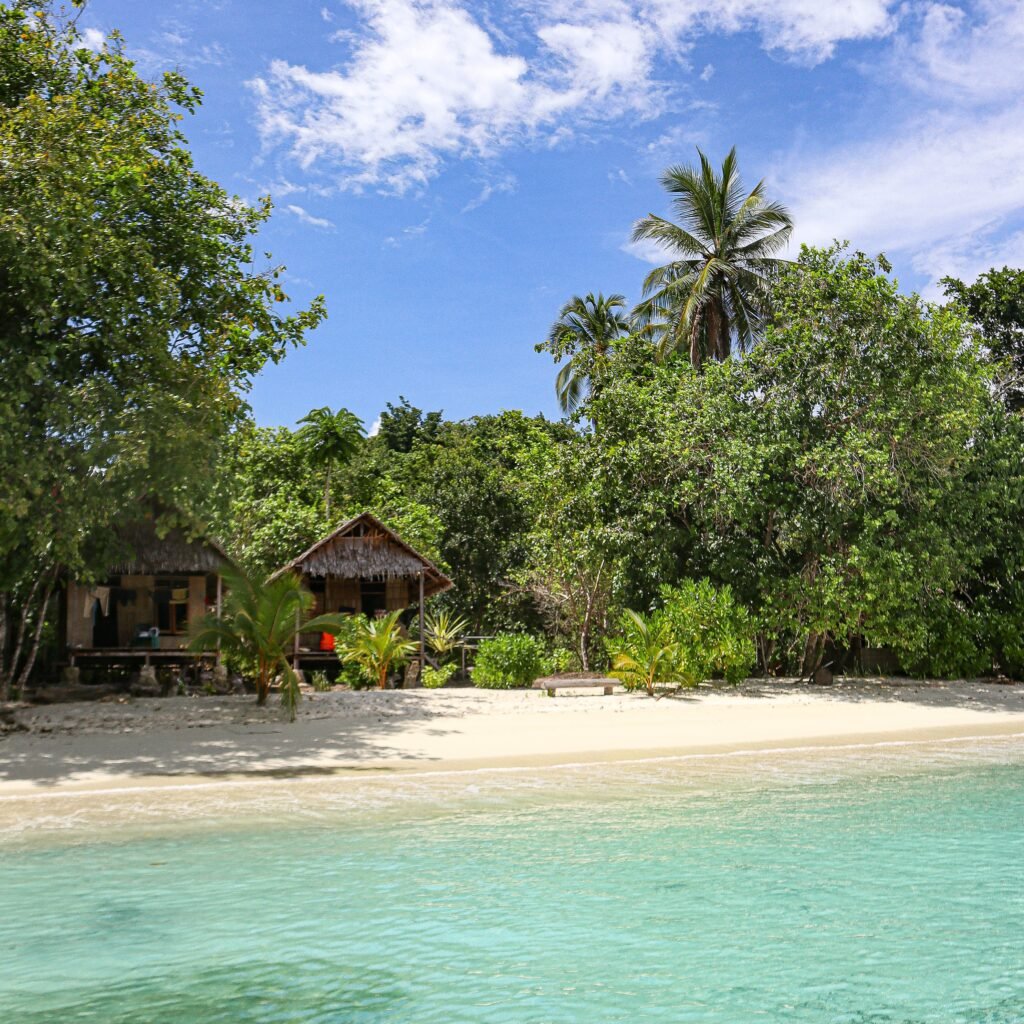
A homestay in Raja Ampat is a simple wooden bungalow run by a local family, usually right on the beach or over the water (you won’t find them inside the jungle, as locals believe it is inhabited by ghosts). Meals are included, bathrooms are usually shared (with some exceptions), electricity is only available in the evening and at night, usually from about 6PM to 6AM, and the level of English varies. Homestays can help you organize activities, and some offer diving (for my full diving guide, read diving in Raja Ampat). This is where most travellers stay, and it’s also the cheaper option: usually IDR 500,000–800,000 per person per night.
Good to know: Comfort is basic, problems are to be expected, and your experience will depend entirely on the family that runs the homestay, so it can vary a lot. On the other hand, it gives you the chance to see exactly how people live in this part of the world.

If you would like more details before making up your mind, jump to living in a homestay, where I cover the day-to-day, with tips, what to expect and what you might need to make your experience run smoothly.
Resorts: What to Expect
If a homestay isn’t for you, Raja Ampat also has a selection of resorts (the closest thing to hotels on the islands), where you can expect electricity all day, private bathrooms, cold drinks and the normal comforts you’re used to when travelling, which in a place like this suddenly feel like luxuries. If this sounds like the right option for you, jump to my resort suggestions.
Good to know: A resort is also the better choice if you have specific food needs (vegetarian, vegan or allergies, which homestays struggle to cater for), back problems that need a proper mattress, if you can’t sleep without AC or are allergic to dogs (many homestays have them). Many resorts also have their own dive center, so you don’t have to organize your diving separately. The trade-off is the price, and the fact that many resorts sell fixed packages of several nights.


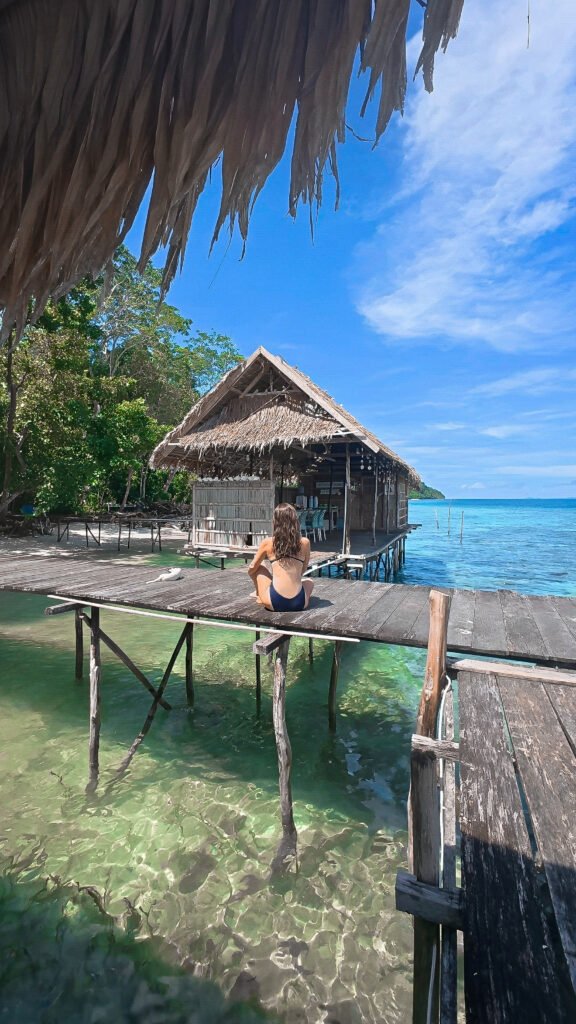
These photos are from two of the cheapest resorts I recommend in Raja Ampat (photos: Andau Dive Resort and Raja Ampat Dive Lodge). Keep reading to see all my picks and their prices.
Homestay vs Resort: A Quick Recap
Here’s a quick recap of everything above, side by side, so you can see at a glance which one is for you.
| Homestay | Resort | |
|---|---|---|
| Price per person per night | IDR 500,000–800,000 | From IDR 1,325,000 |
| Meals | All included, local Indonesian food (it varies a lot by homestay) | All included, a mix of Western and Indonesian |
| Electricity | Evening to morning (about 6PM to 6AM) | All day |
| Bathroom | Usually shared and open | Private |
| Diving | Some organize it, with local guides | Many have their own dive center |
| Where | Everywhere | Just a few, around the main islands (Kri, Gam, Batanta, Mansuar) and one in Misool |
| Best for | Travellers on a budget who can adapt to basic comfort | Travellers who want hotel-style comfort and have the budget for it |
Raja Ampat Resorts and Dive Resorts: The Main Options
I stayed in homestays on both my trips, but before deciding to go to Misool on the second one we considered resorts in the Dampier Strait, so I did a good amount of research on them. If you’d rather spend more for comfort, electricity all day and a dive center on site, here are the main resorts in Raja Ampat, including the dive resorts, all marked on the map below.
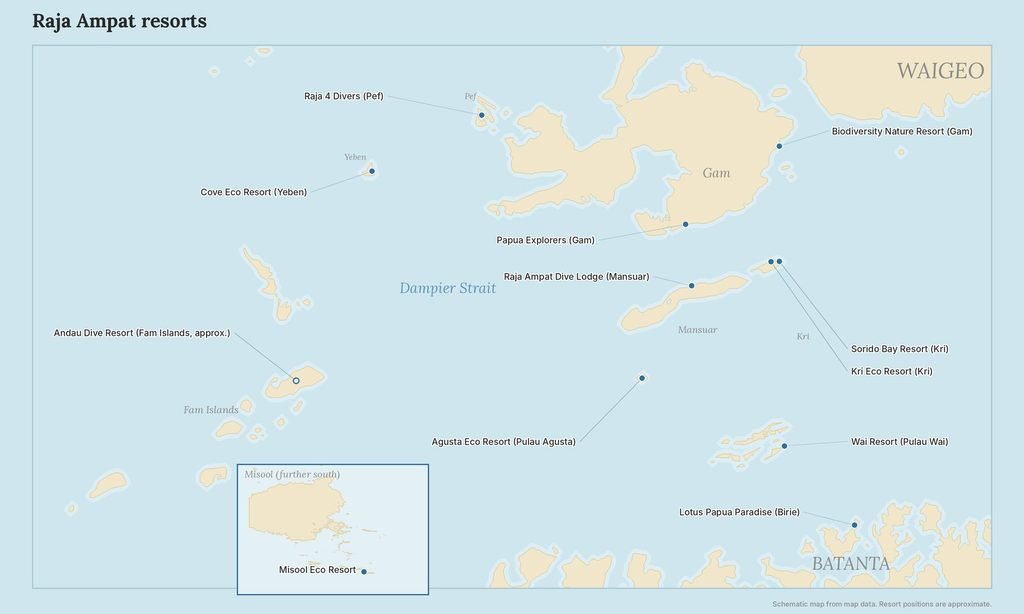
The main resorts in Raja Ampat (Misool is in the box at the bottom)
★ Quick picks
Looking for a “Cheap” Resort? Here Are the Most Affordable Resorts in Raja Ampat
Andau Dive Resort
Fam Islands · the cheapest with the best value
Raja Ampat Dive Lodge
Mansuar · close to all the classic day trips
Wai Resort
Pulau Wai · its own little island near Batanta
All offer trips, excursions and diving on site
Below you can find a table with the price per person per night in a double room, to give you an idea of what each resort costs. Keep in mind that some of these resorts only let you book a fixed number of nights, so check whether they allow a shorter stay (the price would probably be higher).
| Resort | Island | Per person per night |
|---|---|---|
| Andau Dive Resort | Fam Islands | IDR 1,325,000 |
| Raja Ampat Dive Lodge | Mansuar | IDR 2,260,000 |
| Wai Resort | Pulau Wai | IDR 3,100,000 |
| Kri Eco Resort | Kri | IDR 3,140,000 |
| Agusta Eco Resort | Pulau Agusta | IDR 3,260,000 |
| Biodiversity Nature Resort | Gam | IDR 3,770,000 |
| Cove Eco Resort | Yeben | IDR 4,430,000 |
| Lotus Papua Paradise | Birie (Batanta) | IDR 6,760,000 |
| Raja 4 Divers | Pef | IDR 6,885,000 |
| Papua Explorers | Gam | IDR 7,050,000 |
| Sorido Bay Resort | Kri | IDR 7,660,000 |
| Misool Eco Resort | Misool | IDR 12,650,000 |
The prices per night are only an indication, to give you a sense of what each resort costs. Rates change with the season and the room, so always double-check the current rates and what is included (transfers, meals, diving, park fee) with the resort before you book.
Homestay Raja Ampat: How to Find the One for You
Finding a homestay in Raja Ampat isn’t as easy as jumping on Booking.com, typing your destination and seeing the results pop up. You could do it and you would find some places, and if you don’t want to waste time looking it’s probably the easiest solution, but it isn’t the best way to do it.
★ Quick picks
Don’t Want to Spend Days Texting Homestays? Here’s Where I Would Book
Frances Homestay
Mansuar · $ · beachfront and budget-friendly · from IDR 425,000 per person
Nyanse Homestay
Gam · $ · a polished homestay with sea-view rooms · from IDR 450,000 per person
Warahnus Dive Homestay
Kri · $$ · diving on site, close to all the classic day trips · from IDR 600,000 per person
Meos Ambower Homestay
Fam Islands · $$ · near the Piaynemo viewpoints · from IDR 650,000 per person
$ = under IDR 500,000 · $$ = IDR 500,000–800,000 per person per night, two people sharing, as shown on Booking.com in October 2026. Check what’s included (meals, transfers) before you book.
The best way to find a homestay is to use two tools together: StayRajaAmpat and Google Maps.
StayRajaAmpat
It presents itself as THE Raja Ampat booking website, and it’s actually good for reading about the different islands and checking the prices, activities and transport price lists of the different homestays. You can sort by island, and it also has some useful filters, such as diving available on site and en-suite bathroom/toilet. But there are three big caveats:
- Where does the money go? As far as I know, the website is owned by a foreign tourist who travelled there and decided to open it, and it takes a commission from the homestays that are listed. Wouldn’t it be nicer to use your money to support the local economy when you visit places like these?
- The prices are higher than what you pay if you book outside the platform. Going directly to the owner also means you can ask questions and clarify things before booking. Usually you only have to pay a deposit beforehand.
- Not all homestays are on StayRajaAmpat: for example, the ones in Misool aren’t there.
How I’d use it, step by step
1) Filter your accommodation options
This is the accommodation page of the website, where you select the island.
I would ignore the price filter for now, because the price outside the platform will be cheaper anyway.
Under Activities you can select “Has diving centre” (for diving in Raja Ampat, read my diving guide), and under Other features you can select “Has ensuite bathroom/toilet”. You can ignore the other fields.

2) Check the transport and activity price lists
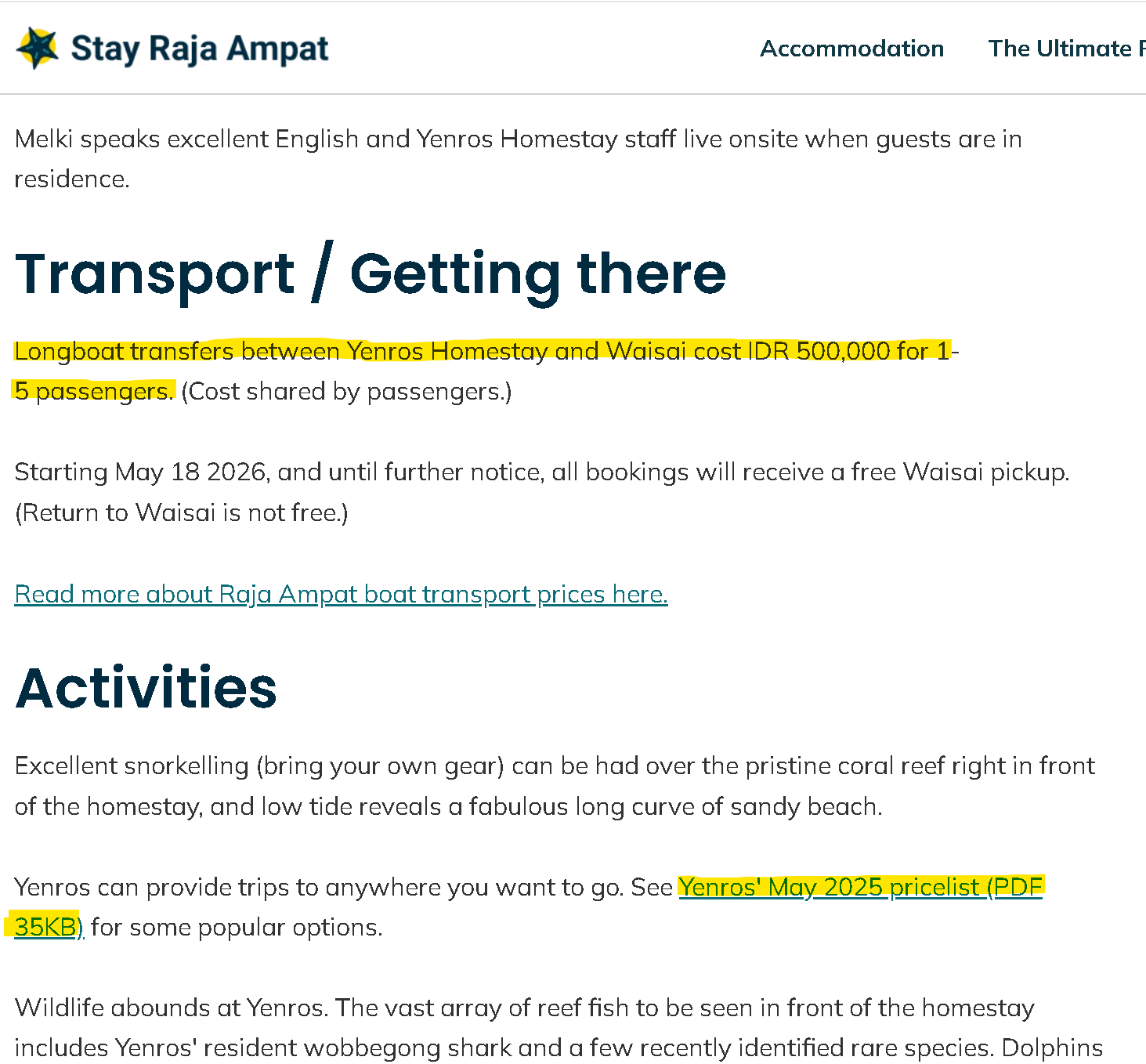
When you are looking at a homestay, here is what to check: the price of getting there, the transport list to other places, and the price list for activities (and for diving, if the homestay offers it: here are my tips for diving). Just remember that the homestay can also organize other activities that are not listed: read my full guide to know the best activities in each part of Raja Ampat.
3) Hop on Google Maps and WhatsApp to complete the booking
Then hop on Google Maps and check whether there are other homestays you hadn’t seen, and re-check the reviews: sometimes they’re different, and in my experience Google reviews are more trustworthy. On Google Maps you’ll also find the owner’s phone number. Message them on WhatsApp to ask about price and availability (usually the direct price is cheaper than the one on StayRajaAmpat), and to confirm the price list you saw on StayRajaAmpat for the things you’re interested in. Just keep in mind that it can take a couple of days to get a reply.
If you are going to Misool or Ayau
The homestays in Misool aren’t on StayRajaAmpat: you can find them on Google Maps, or jump straight to my recommendations in the best homestays by area. The same goes for Ayau, an island you probably don’t know about yet (you should check out my full guide): there’s only one homestay, Ayau Homestay, run by Richard, with 3 bungalows and a minimum stay of 3 nights, and you’ll find its price and phone number in the table below.


What to Check and Ask Before Booking Accommodation in Raja Ampat
- Transfers: will they pick you up in Waisai if it’s your first homestay (they usually do, but check), and how much does it cost? When you move between homestays, ask both of them and compare the price of the transfers between islands. In my complete guide I also explain how to use Facebook groups to find other travellers to share boats with, so the price per person goes down.
- Trips: which trips do they organize, and at what price? If you have specific trips in mind, ask: they can usually organize them.
- Snorkel gear: do they have some to lend or rent? Some homestays do, but not all of them, so if not, bring your own mask, snorkel and water shoes (you’ll find them in the packing list at the bottom of my complete guide).
- Bathroom and beds: is the bathroom en-suite or shared, and what kind of bed and mosquito net do they have?
- Food: if you’re vegetarian, vegan or have allergies, tell them before you arrive and ask what they can do: it’s hard to cater for certain food needs in homestays.
- Electricity and internet: which hours, and do they have Starlink?
- Deposit and cancellation: how much is the deposit, can you get it back, and what happens if the weather stops the boats?
- Payment: cash only, or can you pay by transfer (for example with Wise: see how to pay below)?
- Diving: do they offer diving? On Kri, if your homestay offers diving, you can only dive with them (more in my guide to diving in Raja Ampat).
Paying for Your Homestay
In Raja Ampat you pay for almost everything in cash, and there are no ATMs on the islands. Some homestays accept a transfer via Wise if you agree on it in advance, but always bring cash to be safe. I explain how much to bring and where to withdraw it in my complete guide to the islands of Raja Ampat, and how to budget for the whole trip in my guide to the cost of Raja Ampat.
Wise is very useful while you travel, not just in Asia, both for paying and for moving your money around. I recommend creating an account before you leave, even if you don’t think you’ll need it: if you do need it once you’re there, it’s already set up.
Wise Pay and move your money while travelling with a Wise account
The Best Homestays in Raja Ampat, by Area
Here are the best Raja Ampat homestays I recommend at a glance, with their price per person per night (meals included), the phone number to book directly and a few words on each.
| Homestay | Area | Per person per night | Phone / WhatsApp |
|---|
| Yenros Homestay | Gam (Dampier Strait) | IDR 700,000 | +62 813-4475-2271 (Melki) |
| My favourite: a great house reef, walking sharks every evening and incredible food. | |||
| Batanta Diving Homestay | Dayan (Batanta) | IDR 600,000 | +62 823-1148-2993 (Nikko) |
| Sea-facing bungalows, with mantas and a dugong at your door and fresh fish caught by Nikko. | |||
| Coco Huts Homestay | West Waigeo | IDR 500,000 | +62 822-9716-3763 |
| Recommended by other travellers, with manta snorkeling (Yefnabi, Yeftip, Yefmo and the Pasir Timbul sandbank) and trips to Aljui Bay and Hidden Bay (I haven’t stayed there yet). | |||
| Gloria Dive Homestay | Fam Islands | IDR 500,000 | +62 822-4805-9529 |
| The budget option for diving around Piaynemo, with over-water bungalows. | |||
| Yapap | Misool | IDR 600,000 | +62 821-9121-7966 |
| Great food, a shallow bay perfect for swimming and a good-value 3-day Misool package. | |||
| Ayau Homestay | Ayau | IDR 600,000 | +62 821-9973-6924 (Richard) |
| The only homestay on Ayau: 3 bungalows and a minimum stay of 3 nights. | |||
Always confirm the current price and availability before you book. Hover over a price to see it converted to your currency.
Want to know more about each area? Read my complete guide to the islands of Raja Ampat, my guide to Kri and the Dampier Strait and my Misool guide.
Living in a Homestay: Bungalow, Food, Bathrooms and Trips
So, you’ve decided that a resort is outside your budget (as it is for most people coming here), or you simply want to experience real Papuan hospitality: great news! Here’s a detailed breakdown of what staying in a homestay involves, with my tips to make your life easier once you’re there.
Organization and arrival
The level of English and the responsiveness of homestay owners can vary a lot. It’s very useful to have Google Translate and the Indonesian language downloaded offline. Contact the owners in advance on WhatsApp, organize your pick-ups with them beforehand, and try to get the prices of trips and activities before you arrive.
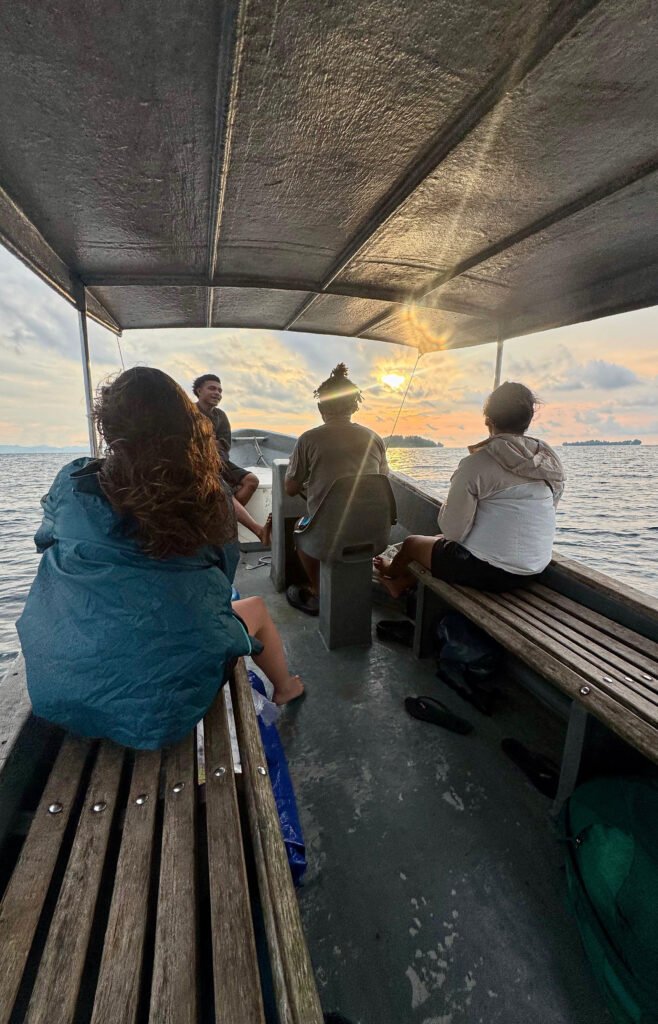
The bungalow
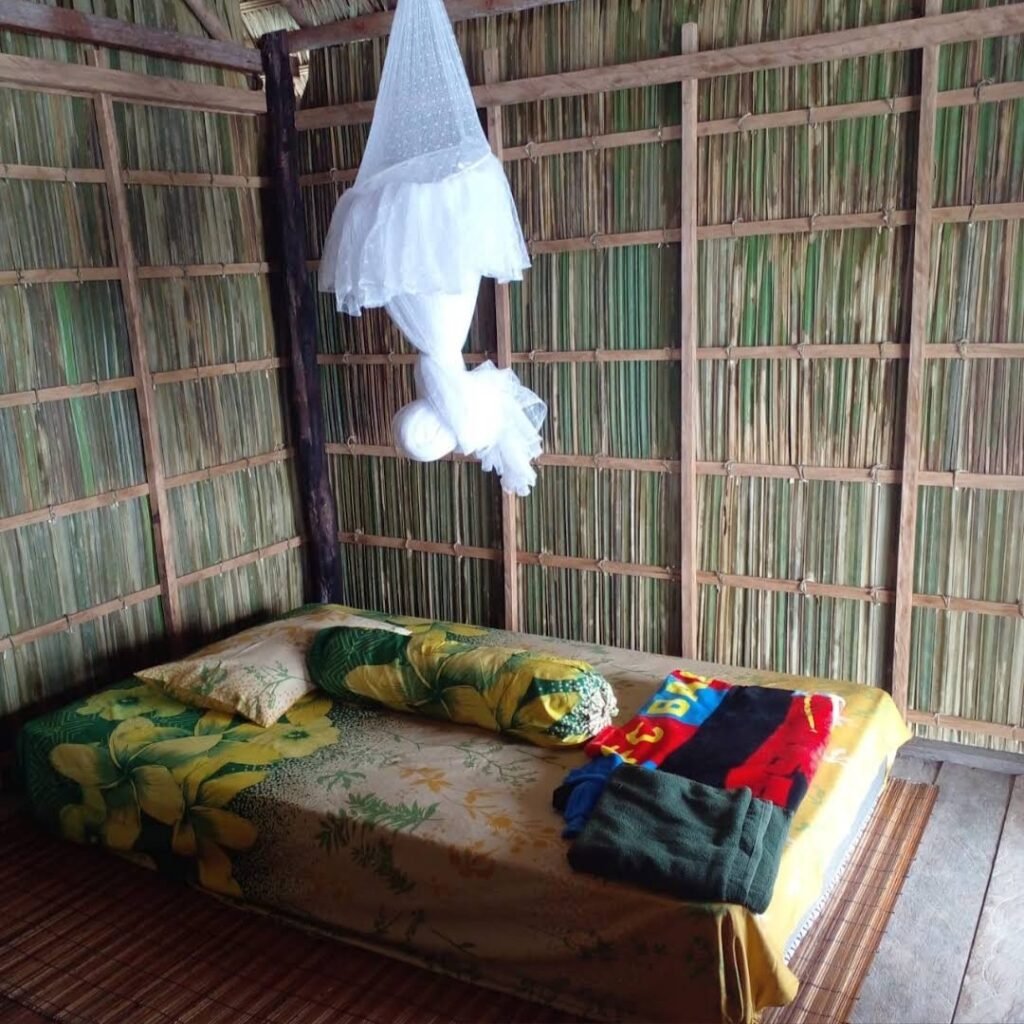
Your bungalow will be quite basic: a mosquito net, a couple of pillows, a thin sheet, and often a rack to dry your clothes. There’s usually a bucket of water to wash your feet before you enter the bungalow (do it, trust me, otherwise your bed will be full of sand in less than 24h and they don’t usually clean the room while you are there unless you ask).
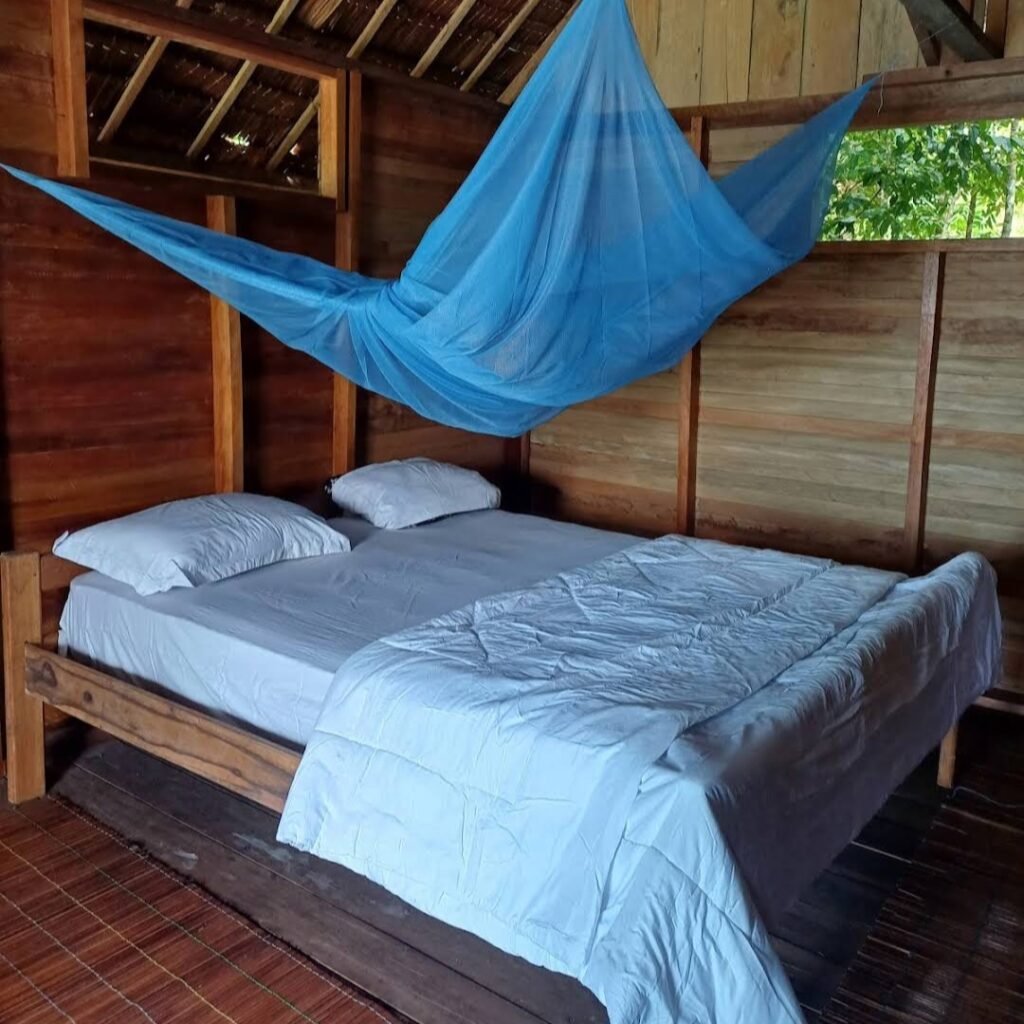
You won’t find towels, toiletries, shampoo or other things, so you need to bring all of that, and often there isn’t a mirror either.
Some homestays lend or rent snorkel gear, but not all of them and sizes can be limited, so ask when you book and bring your own mask if you can.
If you want to wash your clothes, bring some detergent, or one of those bags where you put everything in, shake it and your clothes get washed (you can find them on Amazon).
Electricity usually only runs from the evening to the morning, about 6PM to 6AM, and only inside the bungalows and at specific points so bring a headlamp: you’ll thank me when you’re trying to find the bathroom in the middle of the night. It can always stop (sometimes there’s no electricity for a whole day), so bring a powerful charger. In some places you’ll have Starlink during the same hours and sockets to charge your things are limited, so if you have multiple devices bring a multi-plug.
Do not keep food in your room unless it’s in very well-closed bags: remember, it’s a jungle, so you will just attract insects and mice. Most homestays also don’t have AC, some have a fan, but to be honest I never needed it, as the bungalows are usually quite well ventilated.
A few homestays have en-suite bathrooms: use the filter on StayRajaAmpat or ask the owner before booking. Homestays usually have different kinds of beds (twin and double) and can also add an extra bed to the room, so they work even if you’re travelling with kids.

Bathrooms and showers
This is a hard topic. The toilets and showers are usually shared and located a little further back on land, more in the middle of the trees, and they’re open, so basically anything can enter (it’s a jungle, so yes, I have seen some very scary things in those bathrooms). The toilets are usually typical Indonesian ones, which means no toilet paper (I always bring some, just in case). When there’s no electricity, the shower turns into a bucket kind of situation. If you go to shower during the day, you might want to use a headlamp or a torch, as it’s a bit dark inside and you’ll want to check what’s in there before you enter.
Tip: don’t forget to bring shampoo, body wash and everything else you need. Even if there are small villages where your hosts can take you, it’s not a given that they sell those things. And ladies, do bring plenty of hair ties, because they’re not easy to find.
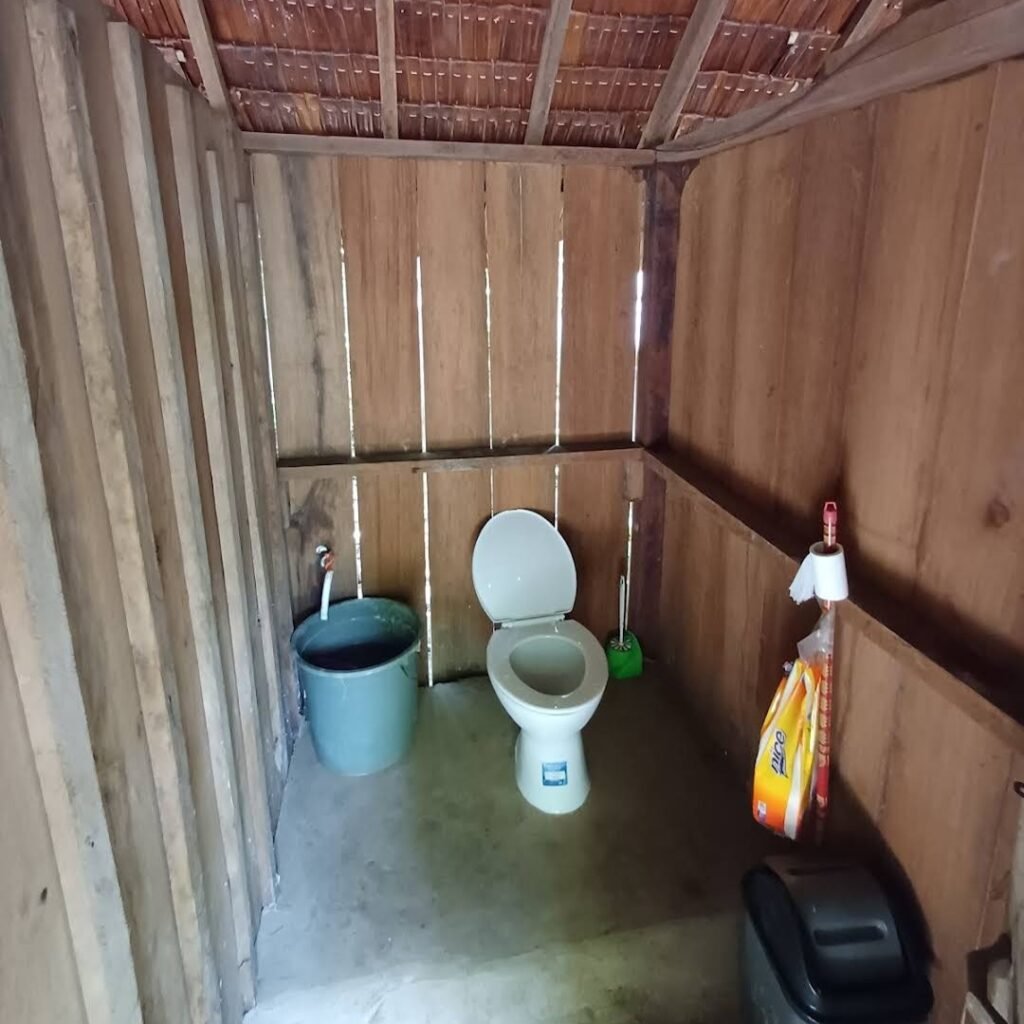
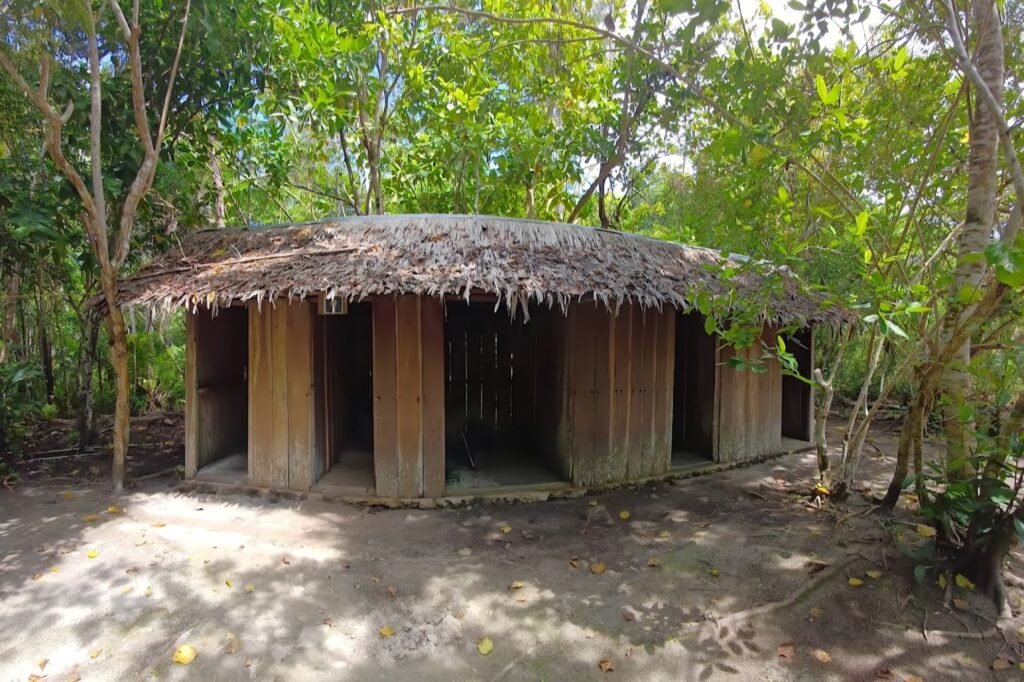

The showers and toilets at Yenros, to give you an idea (photos: Yenros Homestay)
Meals and the dining room
The dining room is where you’ll have all your meals, and water, tea and coffee are available throughout the day. There’s usually a big bottle of water, so if you bring a reusable water bottle you can fill it and take it with you on excursions. Don’t expect to be able to buy soft drinks, and be aware that there usually isn’t a fridge, because of the lack of electricity.
There are usually 4 meals included in your stay: breakfast, lunch, a snack and dinner. They’re all served at specific times, so make sure to ask which ones if they don’t tell you.
The quality and variety of the food vary a lot. I’ve been in homestays where the food was the best I’ve ever had (shout-out to Yenros and Batanta Diving Homestay) and others where it was extremely basic and not very appetizing, so it’s very important to check the reviews. Quantity matters too: the food is served in dishes shared between the different guests, so read the reviews to see whether the homestay serves adequate portions. On diving days and trips you’ll be out all day, so remind them to prepare you a lunch box.
What to expect? It’s usually a base of rice, one or two vegetable dishes, and then meat, fish or both. Most of the fish is kind of dry, but in very good homestays such as Batanta Diving Homestay you’ll get a fresh catch every day, as Nikko goes spearfishing before lunch and dinner. A lot of the food is heavy on oil, so if that’s an issue for you, bring medicine that can help. There’s usually always some fruit, and the snack is usually banana fritters or something similar. At times you’ll get eggs and tempeh, but that’s less common.
This isn’t really the kind of place that accommodates dietary requirements, as the food options are quite limited. If you’re vegetarian, vegan or have allergies, tell your homestay before you arrive and ask what they can prepare for you. If you want to drink alcohol, ask your taxi driver to stop at a liquor store in Sorong on the way to the ferry.
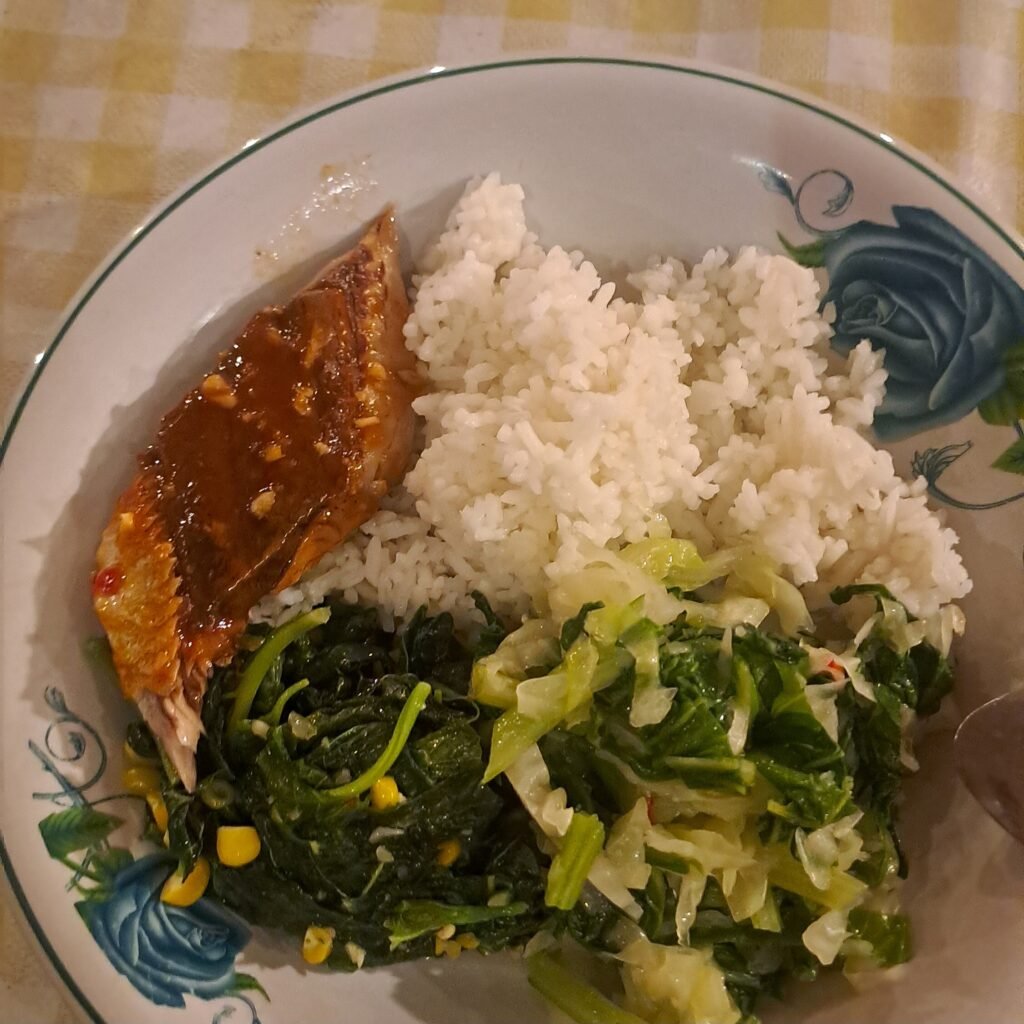
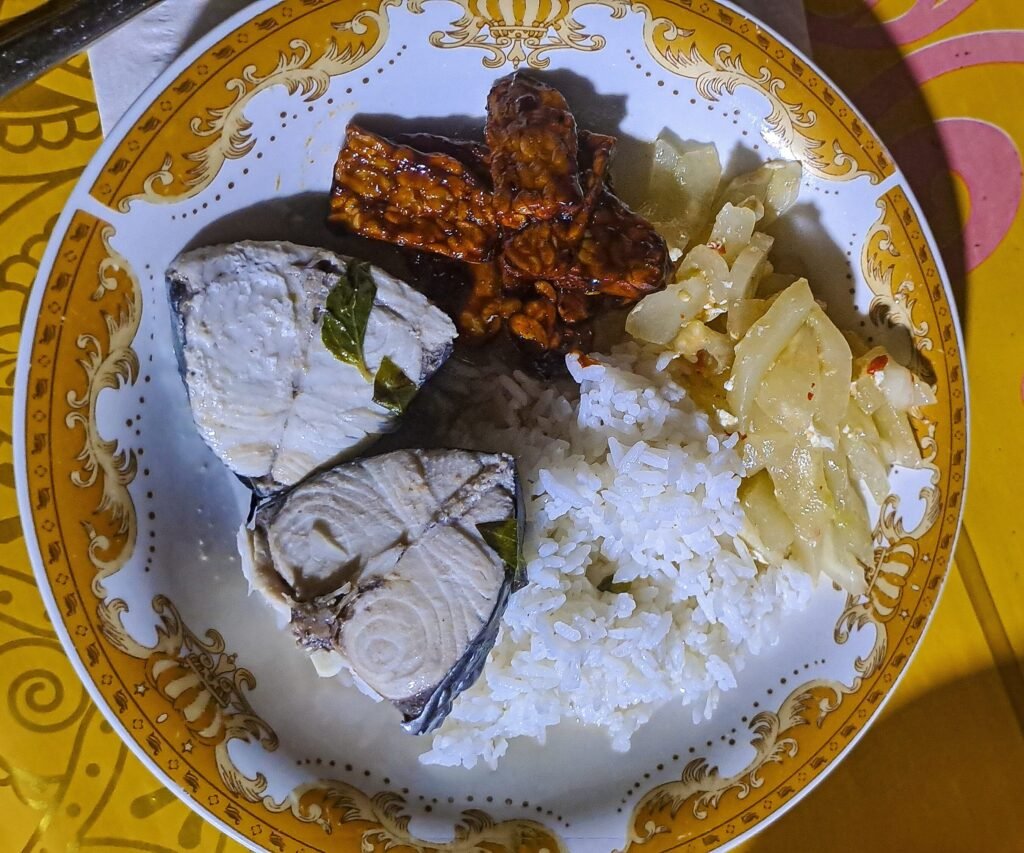
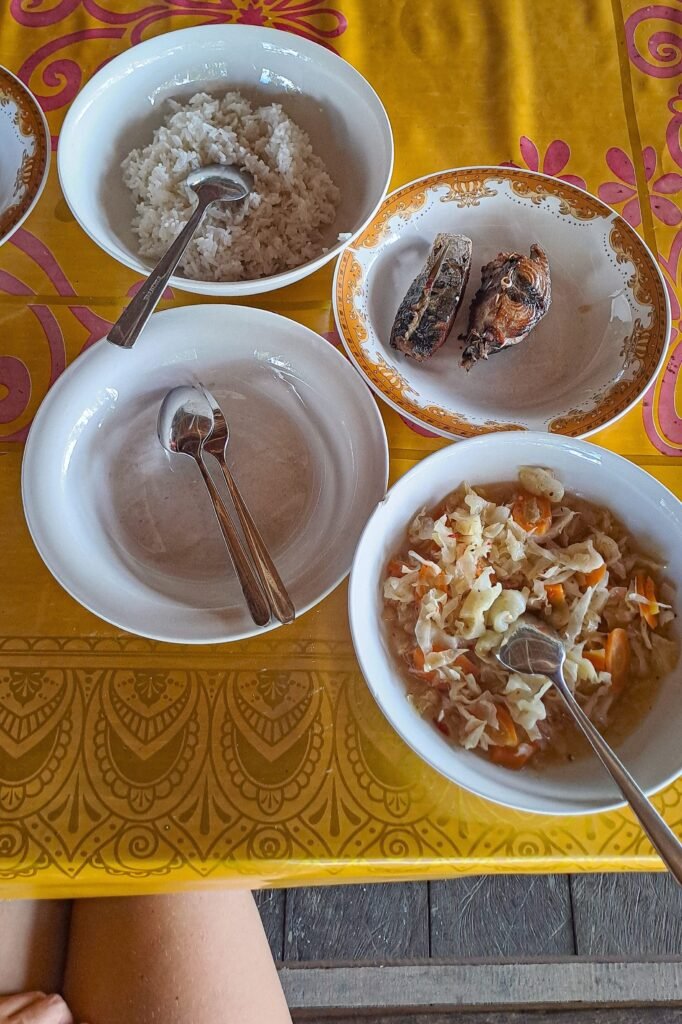
Meals at Yenros: this is what a good homestay serves. At Batanta Diving Homestay it was on another level, with fresh fish every day
Beach and reefs
One of my most vivid memories of Raja Ampat will always be how incredible the corals were, even just from walking along the dock in front of your homestay. So don’t worry if you don’t want to take a boat trip every day. You can simply wake up, grab your snorkel, jump into the water, and still have a snorkeling experience that’s better than what you’d find in most other places in the world.
Some homestays have a beach right in front where you can relax, but that’s not always the case.
Be aware of two things: 1) there might be stonefish around, so bring water shoes; 2) do not step on the corals. The corals in Raja Ampat have already suffered in recent years and homestays are trying to protect them: at Yenros, for example, if you were seen standing on the corals multiple times, they could ask you to leave the homestay.
Some of the house reefs are very nice, but to see the best sites you still need to organize trips.

Trips
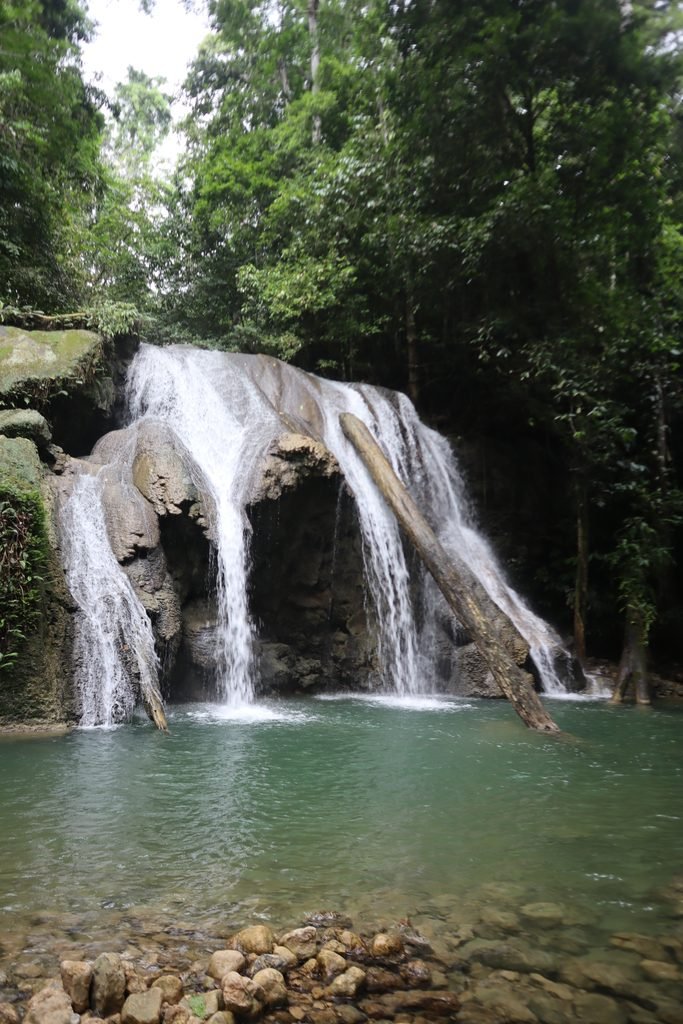
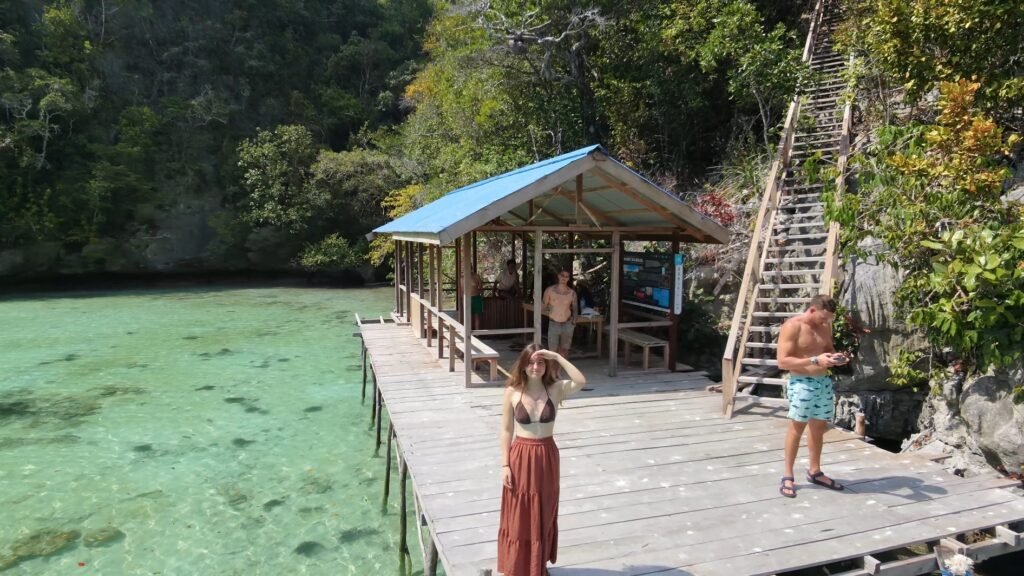
All homestays offer snorkeling trips and other kinds of activities. Many have a price list published on StayRajaAmpat (see how to find a homestay above to learn how to use the website effectively), while other activities aren’t written anywhere: they can still organize them, but you’ll need to agree the price with the owner. Let them know in advance what you want to do, as in some cases they’ll need to make arrangements. Read my complete guide to learn about the ones most people don’t know they can do, like stingless jellyfish, mandarin fish or visiting pearl farms.
The prices are per boat, so if you can coordinate with other people, from your homestay, the ones nearby, or even people you meet on the boat or on Facebook, the price per person goes down. The Facebook groups for trips here are a huge resource: the first time I went, I coordinated with a Belgian guy and we went to the same places and shared the activities.

Sundays
On Sundays most families go to church, so trips and activities are usually limited: it’s the perfect day to stay on the house reef. Homestays still transfer you to another homestay on Sundays, and you can still do activities at the homestay in the afternoon. The dive centers don’t dive on Sundays either, so plan your boat trips and dives for the rest of the week.
Church is at the centre of village life here, and I’ve been to a few services in remote parts of Indonesia: every time it was a magical experience, nothing like a normal church service in any Western country. If you want to join, just ask! Many families will be happy to take you along.

Where to Stay in Waisai or Sorong (Before and After Your Trip)
Most people head straight to the islands, but you may need a night in Sorong or Waisai if your flight and the ferry don’t line up, or if you have an early flight home. I explain how to get from the airport to the ferry, and what Sorong is like, in my complete guide to the islands of Raja Ampat.
While spending the night in Sorong I stayed at the ASTON Sorong Hotel & Conference Center: it cost about IDR 1,470,000 for two people for one night. It’s definitely not the cheapest option, but it’s right in front of the airport, and before or after the homestays a bit of comfort is welcome. Sorong doesn’t feel like the safest place, so I’d rather spend a bit more for a better hotel.
Raja Ampat Homestay FAQ
Can You Book Homestays on Booking.com or Airbnb?
Some of them, yes, and it’s the easiest way if you don’t want to waste time looking, but most homestays aren’t listed there, and the best way to find them is StayRajaAmpat together with Google Maps (see how to find a homestay).
How Much Does a Homestay in Raja Ampat Cost?
The price of a homestay usually includes your room and your meals, and nothing else, unless there’s a promotion. Transfers, trips, drinks and diving are almost always extra. As an average, expect IDR 500,000–800,000 per person per night.
Tip: the room is only a minimum part of what Raja Ampat costs. Boat transfers and trips often cost more than the room itself, and then there are the permits, the ferry and any diving. Keep that in mind when you compare prices.
For a full breakdown of what a trip costs, from transfers and trips to diving, check out my guide to the cost of Raja Ampat.
To give you an idea, Ayau Homestay costs IDR 1,200,000 per night for two adults (IDR 600,000 per person) with three meals included. You can see the prices of my favourite homestay here: Hut for Rental in Raja Ampat Gam | Yenros Homestay.
Do You Need to Book a Homestay in Advance?
In the Dampier Strait, not necessarily. But the internet connection on the islands is poor (both for you and for homestay owners), so contacting them in advance is useful, also because they can take a few days to reply. As a general rule, book at least your first homestay, because they need to pick you up at the ferry port. For Misool and Ayau, yes, book ahead: the choice of homestays is very limited, so you want to make sure they have space.
If you’re planning to dive, book your diving before you arrive too: I explain how far ahead in my guide to diving in Raja Ampat.
Deposits, Cancellations and Bad Weather: What Happens If the Boats Can’t Run?
Weather can and does change your plans in Raja Ampat: in September, when we went to Misool, the wind was so strong that on some days the boats couldn’t go out. That’s why it’s worth asking, before you pay anything, how much the deposit is and whether you can get it back if the ferry, a flight or the boats can’t run.
Are Homestays in Raja Ampat Safe for Solo Travellers, Couples and Families?
I never felt unsafe in Raja Ampat, even in Sorong, which looks a bit rough but was fine. The real risks are about being remote: the nearest proper medical care is in Sorong, so get travel insurance that covers you for it (more in my complete guide).
Is There Wifi or Phone Signal in the Homestays?
Very little. The signal is patchy and often absent, and the homestays that have Starlink usually only switch it on in the evening, together with the electricity. Owners can take a couple of days to reply to messages, so contact them well in advance, and download maps and Google Translate before you leave Sorong. I break down the signal island by island in my guide to Kri and the Dampier Strait, and where to buy a Telkomsel SIM in my complete guide.
Are There Hotels in Raja Ampat?
On the islands, what you’ll find is homestays and a few resorts. If you need a regular hotel for the night before or after your trip, see where to stay in Waisai or Sorong.
Planning Your Stay in Raja Ampat
Not sure where to stay in Raja Ampat? Choose your area first, then your homestay: where you stay decides what you can do, and moving between islands is expensive. Start with my complete guide to the islands of Raja Ampat to pick the right area, then use this guide to find and book the right homestay.
If you have any questions, leave a comment below. I’m always happy to help you plan your trip!
Check out my pictures and stories on Instagram for some inspo:
Disclosure: some links in this post are affiliate or referral links. If you book or sign up through them, I may earn a small commission, at no extra cost to you.